Understand
Read a principle and work through a fictional situation.
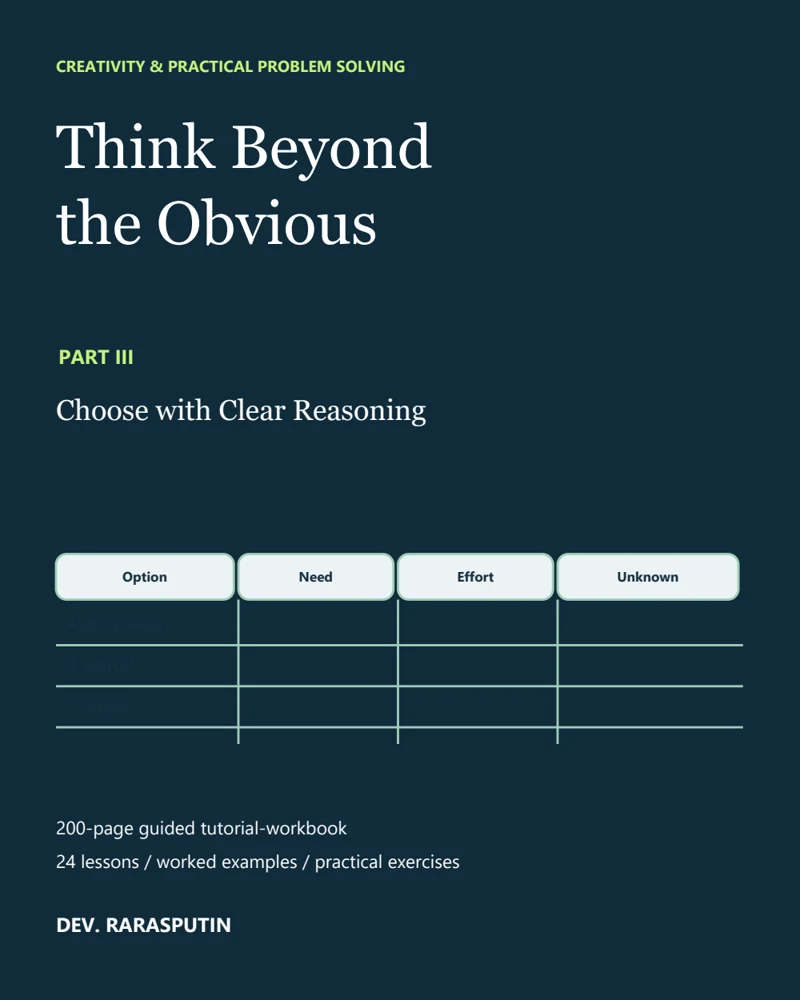
Creativity & practical problem solving / Part III
Compare ideas, uncertainty and practical trade-offs.
200-page tutorial-workbook / 24 lessons / $5 USD
Publication forthcoming / $5 USD
Substantial guided writing and planning space. PDF plus practical templates; each part is sold separately.
Learn by doing
Read a principle and work through a fictional situation.
Inspect two routes and the assumptions behind them.
Apply the skill to one manageable real challenge.
Record evidence, limits and your next useful decision.
A fictional worked example
Asha compares workshop arrival options by clarity, access, ongoing work and setup effort.
Clarity means a newcomer can find the correct entrance from the invitation.
The comparison now has a shared basis without claiming objective certainty.
Illustrative teaching example, not a testimonial or measured result.
Explore the sample lessonInside this volume
Criteria describe what matters for the choice. Agree them before scoring alternatives so they do not shift to favor a preferred idea. Define vague terms in observable language.
Try it: Create four criteria and a plain definition for each.
Check: Could two people apply your definition in a similar way?
A mandatory requirement is a gate, not a bonus that can be offset by attractive features. Evaluate it before weighted preferences. Confirm who has authority to set or change the gate.
Try it: Write gates separately from preferences for your shortlist.
Check: Which requirement would disqualify an otherwise attractive option?
Comparable concept cards reduce presentation bias. Describe purpose, mechanism, resources, limitations and unknowns in the same order. Avoid comparing a polished mockup with a vague sentence.
Try it: Rewrite two alternatives using one common template.
Check: Which option currently benefits from better packaging?
Keeping the present approach is a candidate with benefits and costs. Compare it under the same assumptions as new options. A redesign must justify its transition burden as well as its eventual benefit.
Try it: Add a baseline concept card to your shortlist.
Check: What does changing add beyond what already works?
A score based on observed behavior differs from one based on a forecast. Label the basis of each rating. Unknown should remain unknown rather than being turned into a comfortable middle score.
Try it: Label every rating as observed, estimated or unknown.
Check: Which attractive score has the weakest support?
A matrix makes judgments visible; it does not choose independently. Use a small scale with clear anchors and explain each rating. Keep raw judgments available alongside totals.
Try it: Build a small matrix and add a reason to each score.
Check: Can you explain a rating without pointing only to its number?
Weights express relative priorities rather than scientific constants. They can help make trade-offs explicit, but a small change may reverse the ranking. Treat a narrow lead as a reason to investigate.
Try it: Try two plausible sets of weights and compare rankings.
Check: Would the decision survive a reasonable priority change?
Several criteria may describe the same underlying benefit. Counting them separately can inflate its influence. Combine overlapping terms or explain why they represent different effects.
Try it: Audit your criteria for repeated benefits.
Check: Which benefit is being rewarded more than once?
A strong option can still impose a cost. State the benefit chosen and the burden accepted. This is more useful than describing the selected concept as best in every respect.
Try it: Write a trade-off sentence for each leading option.
Check: Who bears the cost of your preferred benefit?
One option may be no better on any relevant criterion and worse on at least one, under the same assumptions. It can then be set aside unless a missing feature or uncertainty changes the comparison.
Try it: Inspect whether one candidate is consistently weaker than another.
Check: What evidence could restore the option you set aside?
Setup is only part of an idea's cost. Updating, staffing, correcting and supporting it continue after launch. Identify who owns those tasks and whether capacity exists.
Try it: Write a one-month operating checklist for each finalist.
Check: What must keep happening after the exciting launch day?
An eventual improvement may cause temporary confusion while people move from the old arrangement. Describe the changeover, duplicate work and recovery route. Include them in the comparison.
Try it: Map what existing users would encounter during the first week.
Check: Where will someone following an old instruction end up?
Uncertainty affects how confidently you should choose. A high-potential option with weak evidence may deserve a small test rather than immediate adoption or rejection. Name what can be learned cheaply.
Try it: Choose one unknown that deserves a check before selection.
Check: Which unknown could most change the shortlist?
A scenario explores how an option behaves under a different set of conditions. It is not a forecast. Choose relevant conditions such as a busy day, absent helper or offline visitor.
Try it: Test finalists against ordinary, crowded and disrupted situations on paper.
Check: Which realistic condition makes your favorite weakest?
An option can improve the average experience while leaving a group without a usable route. Examine access, language, timing and required resources with affected people where possible.
Try it: Inspect a concept from the position of someone lacking one assumed resource.
Check: What must a person possess to use this option?
An idea may be appealing but currently impractical, or easy to deliver but unhelpful. Evaluate these questions separately so convenience does not masquerade as value.
Try it: Describe one desirable but difficult and one easy but weak option.
Check: Would anyone benefit if the easy option were delivered perfectly?
A favorite deserves scrutiny because familiarity and personal effort can make its weaknesses harder to see. Apply the same critical questions you would use for a competing option.
Try it: Write a strong, fair objection to your preferred idea.
Check: What would you ask if someone else proposed this?
People may disagree because they prioritize different outcomes, use different facts or imagine different conditions. Locate the difference before voting. Some disagreements can be investigated; others require an explicit authority decision.
Try it: Rewrite a disagreement as a factual question and a priority question.
Check: What kind of disagreement are you actually having?
Define when you have enough information for this level of commitment. Endless comparison can consume more resources than a reversible test. Match analysis to consequence and keep unresolved limits visible.
Try it: Write what must be known and what can wait until a pilot.
Check: What additional information would actually change today's next step?
A recommendation states the choice, reasons, trade-offs and uncertainties. It should distinguish adopting an option from authorizing a small test. Include the decision needed from the reader.
Try it: Write a recommendation in six plain sentences.
Check: What exactly are you asking the reader to approve?
A short record preserves what was known when the choice was made. It helps later review avoid rewriting expectations after the result. Include assumptions and a review trigger, not only the selected option.
Try it: Create a decision note with one explicit uncertainty.
Check: What future change would make the original reasons no longer apply?
The next choice may be a limited experiment rather than a permanent system. Specify boundaries that make reversal real, including time, resources and effects on others.
Try it: Rewrite a large commitment as a genuinely bounded next step.
Check: What exactly can be reversed when the trial ends?
A final check asks whether the selected option still answers the original brief and meets the mandatory conditions. Detailed evaluation can drift toward an attractive but different problem.
Try it: Trace your recommendation back to the original evidence.
Check: Which part of the original problem will this choice improve?
A selection dossier collects the brief, alternatives, criteria, evidence and recommendation. It should be short enough for another person to challenge. Keep rejected options and their reasons available for later learning.
Try it: Prepare a concise selection record with one unresolved question.
Check: Could another person explain why this option was chosen?
Your working space
Choose a lesson, describe your challenge and keep the reasoning visible. Save stores entries in this browser only. Download a copy for another device. There is no account or cloud sync.
The complete learning path
Each volume contains 200 numbered pages, including substantial practice and writing space. This is a tutorial-workbook series, not a video course or interactive PDF form. Ordinary examples are fictional. Results depend on context, judgment and practice.